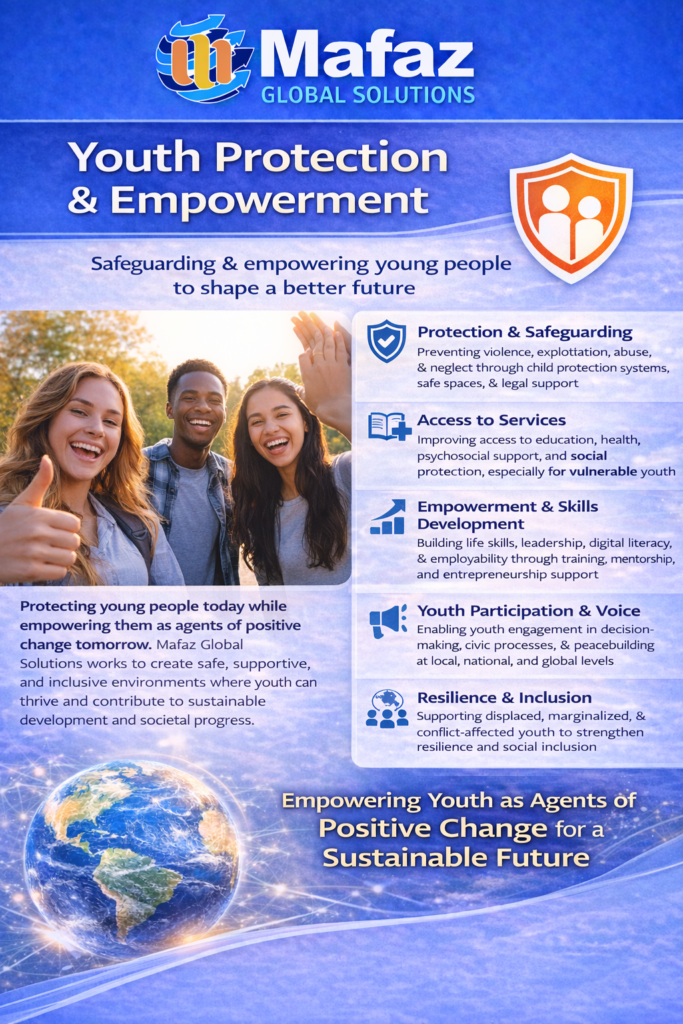
Youth Protection & Empowerment is central to building peaceful, resilient, and inclusive societies, particularly in contexts affected by conflict, fragility, and instability. Young people face multiple and interconnected risks that threaten their safety, dignity, and future, including violence, exploitation, abuse, and illegal recruitment into armed groups. Protecting youth from these threats while empowering them with opportunities, skills, and a voice in society is essential for sustainable development and long-term stability.
One of the most serious protection concerns facing youth today is the illegal recruitment and use of underage individuals by armed groups, militias, and criminal networks. Children and adolescents are often targeted due to poverty, displacement, lack of access to education, family separation, and weak protection systems. In many cases, recruitment occurs through coercion, intimidation, or abduction, while in others it is driven by manipulation, misinformation, or false promises of income, security, and belonging. Once involved, underage youth may be forced to carry weapons, participate in violence, or support armed activities, exposing them to extreme physical danger and psychological trauma.
The impact of such experiences is profound and long-lasting. Exposure to armed violence disrupts education, damages mental health, and undermines social development, often leaving youth stigmatized and excluded from their communities. These harms extend beyond the individual, weakening families, eroding social cohesion, and perpetuating cycles of violence and insecurity. Addressing illegal recruitment is therefore not only a protection priority but also a critical peacebuilding and development imperative.
Youth Protection & Empowerment responds to these challenges through prevention, support, and long-term solutions. Strengthening child and youth protection systems at community and institutional levels is key to identifying risks early and creating safe environments where young people are protected from harm. Awareness-raising, community engagement, and collaboration with families, schools, civil society, and local leaders play a vital role in preventing recruitment and reducing vulnerability.
Empowerment is equally essential in breaking the conditions that expose youth to exploitation. Access to quality education, psychosocial support, life skills, vocational training, and livelihood opportunities provides young people with viable alternatives to armed involvement and restores hope for the future. Empowered youth are better equipped to make informed choices, resist manipulation, and contribute positively to their communities. Supporting youth participation in civic engagement, peacebuilding, and decision-making processes further reinforces their role as agents of change rather than victims of conflict.
For youth affected by armed recruitment, reintegration and recovery are critical. Comprehensive support that includes psychosocial care, education, skills development, and community reconciliation helps young people rebuild their lives and reduces the risk of re-recruitment. Inclusive, youth-centered approaches ensure dignity, resilience, and long-term reintegration.
Ultimately, Youth Protection & Empowerment is about safeguarding rights while unlocking potential. By protecting young people from illegal recruitment and violence and investing in their skills, wellbeing, and leadership, societies can transform vulnerability into strength and empower youth to drive peace, stability, and sustainable development.
Peace & Community Integration lies at the heart of sustainable development and long-term stability. In a world shaped by migration, social change, and complex global challenges, communities need inclusive approaches that strengthen trust, encourage dialogue, and create shared opportunities for growth. At Mafaz Global Solutions, our Peace & Community Integration work focuses on building strong, resilient societies where individuals and groups can live together with dignity, mutual respect, and a sense of belonging.
We believe that peace is not only the absence of conflict, but the presence of fairness, inclusion, and cooperation. Communities thrive when people feel safe, valued, and connected to one another. Our programs are designed to address social divisions, support integration processes, and empower communities to work collectively toward common goals.
Strengthening Social Cohesion
Social cohesion is essential for peaceful and stable communities. Rapid urbanization, displacement, economic pressures, and cultural differences can create barriers between groups if not addressed thoughtfully. Through community-based initiatives, dialogue platforms, and collaborative activities, we help foster understanding and cooperation among diverse populations.
Our approach promotes positive interaction between host communities, migrants, youth, and local stakeholders. By encouraging open communication and shared problem-solving, we help reduce misunderstandings and build relationships based on trust. These efforts strengthen community networks, enhance resilience, and create environments where diversity becomes a source of strength rather than division.
Inclusive Community Engagement
Meaningful participation is a key pillar of integration. Communities are more sustainable when local voices shape the solutions that affect their lives. Mafaz Global Solutions works closely with community leaders, civil society organizations, and grassroots groups to ensure that programs reflect real needs and priorities.
We design participatory workshops, community forums, and collaborative planning sessions that bring people together around shared challenges and opportunities. Special attention is given to the inclusion of youth, women, and marginalized groups, ensuring that integration efforts are equitable and representative. By empowering individuals to take part in decision-making, we help communities develop a sense of ownership and responsibility for lasting peace.
Youth as Agents of Integration
Young people play a powerful role in building bridges between cultures and generations. Our Peace & Community Integration initiatives support youth leadership, peer engagement, and community service programs that encourage positive social change. Through mentorship, skills development, and creative initiatives, young people gain the confidence and tools to become active contributors to peaceful societies.
Youth-led activities such as cultural exchanges, volunteer projects, and community dialogue sessions help break down stereotypes and promote understanding. By investing in young leaders, we help create a new generation committed to cooperation, innovation, and shared progress.
Supporting Migrant and Host Community Relationships
Migration can bring both opportunities and challenges to communities. Successful integration requires balanced support for both newcomers and host populations. Our programs aim to strengthen relationships by promoting mutual understanding, access to services, and inclusive local development initiatives.
We work to ensure that integration efforts are practical and community-centered, focusing on language access, cultural orientation, and community engagement. By connecting local institutions, service providers, and community members, we help create welcoming environments that benefit everyone. Integration is most successful when it supports social harmony while recognizing and respecting cultural diversity.
Dialogue, Mediation, and Conflict Prevention
Community tensions often arise from misunderstanding, limited resources, or lack of communication. Mafaz Global Solutions facilitates dialogue processes that help communities address concerns peacefully and collaboratively. Our methods emphasize listening, empathy, and constructive problem-solving, enabling communities to resolve differences before they escalate.
Through training programs and capacity-building initiatives, we equip local leaders and organizations with tools for mediation, communication, and inclusive governance. These skills help communities navigate challenges while maintaining a spirit of cooperation and respect.
Partnerships for Sustainable Peace
Collaboration is central to our Peace & Community Integration work. We partner with governments, UN agencies, civil society organizations, educational institutions, and community networks to create coordinated and impactful programs. Strong partnerships allow us to combine local knowledge with global expertise, ensuring that solutions are practical, culturally relevant, and sustainable.
By aligning our initiatives with national development priorities and international frameworks, we contribute to broader efforts that promote social stability and inclusive growth. Our partnership model encourages shared learning, innovation, and long-term collaboration among stakeholders.
Evidence-Based and Community-Driven Solutions
At Mafaz Global Solutions, we believe that effective integration strategies must be guided by research, data, and real community experiences. We apply monitoring and evaluation frameworks to measure impact, understand community dynamics, and refine our approaches over time. This evidence-based methodology ensures that our programs remain responsive, adaptable, and effective in changing environments.
Community feedback is an essential part of our process. By listening to participants and local partners, we continuously improve our initiatives to reflect evolving needs and priorities. This commitment to learning helps us deliver programs that create meaningful and measurable change.
Building Resilient Futures Together
Peace & Community Integration is not a one-time effort—it is an ongoing process that requires commitment, collaboration, and innovation. Our vision is to support communities where diversity is embraced, dialogue is encouraged, and shared values guide collective action. By strengthening relationships, empowering local leaders, and promoting inclusive development, we help communities build a foundation for lasting stability and growth.
Through our work, Mafaz Global Solutions aims to transform challenges into opportunities for connection and cooperation. We strive to create environments where individuals feel safe, respected, and empowered to contribute to their communities. Together with our partners and stakeholders, we are building pathways toward a more inclusive, peaceful, and integrated future.
Strong governance and effective institutions are essential for sustainable development, social stability, and inclusive economic growth. Governance, Policy & Institutional Strengthening focuses on helping governments, public institutions, and partner organizations build systems that are transparent, accountable, and responsive to the needs of people. By improving how policies are designed, implemented, and evaluated, this focus area contributes to long-term resilience and better public service delivery.
At its core, governance is about how decisions are made and how resources are managed for the public good. Many countries and communities face complex challenges such as limited administrative capacity, fragmented policy frameworks, or gaps between national strategies and local implementation. Through targeted technical support, capacity building, and collaborative partnerships, programs in this area aim to close these gaps and create institutions that are more effective, inclusive, and sustainable.
A key component of Governance, Policy & Institutional Strengthening is policy development and reform. Evidence-based policy design ensures that strategies respond to real needs and are grounded in research, data, and stakeholder consultation. This includes supporting governments to draft new policies, revise existing frameworks, and align national strategies with international commitments such as the Sustainable Development Goals (SDGs). By integrating data analysis, community input, and cross-sector expertise, policies become more practical, realistic, and impactful.
Another important element is institutional capacity building. Institutions are only as strong as the systems and people that sustain them. Programs often focus on strengthening leadership skills, strategic planning, financial management, digital governance, and service delivery mechanisms. Training workshops, mentoring programs, and peer-to-peer learning exchanges help public officials and organizational leaders build the skills needed to manage complex programs effectively. Over time, this investment in human capital creates institutions that are more resilient and better prepared to respond to evolving challenges.
Transparency and accountability are also central to strong governance. Communities need to trust that decisions are made fairly and that public resources are used responsibly. Governance initiatives may support the development of monitoring systems, open data practices, and community feedback mechanisms that encourage participation and oversight. When citizens are informed and engaged, institutions are more likely to deliver services efficiently and equitably. Strengthening accountability processes not only improves outcomes but also builds confidence between institutions and the communities they serve.
In many contexts, governance challenges arise from limited coordination between different sectors or levels of government. National policies may not fully reflect local realities, and local actors may lack the resources or authority to implement programs effectively. Governance strengthening efforts often promote multi-stakeholder coordination, bringing together government agencies, civil society organizations, development partners, and the private sector. By fostering collaboration and shared responsibility, these initiatives help align priorities, reduce duplication, and maximize the impact of available resources.
Digital transformation is becoming increasingly important in modern governance. Technology can improve efficiency, enhance transparency, and expand access to services, especially in remote or underserved areas. Institutional strengthening programs may support the introduction of digital systems for data management, public service delivery, and performance monitoring. However, digital solutions must be inclusive and secure, ensuring that they protect privacy while remaining accessible to all communities. By integrating technology thoughtfully, institutions can become more agile and responsive to the needs of citizens.
Governance, Policy & Institutional Strengthening also emphasizes inclusive participation. Effective policies must reflect the perspectives of diverse groups, including youth, women, marginalized communities, and people affected by displacement or conflict. Participatory approaches encourage dialogue, empower communities, and help decision-makers understand local priorities. When individuals feel that their voices matter, they are more likely to engage in civic processes and support collective solutions.
In fragile or rapidly changing environments, strong institutions play a crucial role in promoting stability and resilience. Governance initiatives may focus on strengthening local governance structures, improving crisis response coordination, and supporting long-term planning that balances immediate needs with sustainable development goals. By building systems that can adapt to uncertainty, institutions are better equipped to navigate social, environmental, and economic challenges.
Another important aspect of this focus area is monitoring, evaluation, and learning (MEL). Effective governance requires continuous improvement, which depends on measuring progress and learning from experience. Programs often establish frameworks that track performance indicators, assess policy outcomes, and identify areas for refinement. By fostering a culture of learning and innovation, institutions can adapt their approaches and ensure that policies remain relevant and effective over time.
Partnerships are at the heart of Governance, Policy & Institutional Strengthening. Collaboration with governments, United Nations agencies, civil society organizations, and development actors helps ensure that initiatives are aligned with national priorities and global best practices. These partnerships enable knowledge sharing, resource mobilization, and coordinated action, creating solutions that are scalable and sustainable. Working together also promotes consistency across sectors, which is essential for addressing complex challenges such as migration, climate change, and social inclusion.
Sustainability is a guiding principle throughout this work. Rather than creating temporary solutions, governance strengthening focuses on building systems that continue to function long after specific projects end. This includes supporting local ownership, strengthening institutional frameworks, and embedding best practices into existing structures. By prioritizing sustainability, institutions become more self-reliant and capable of driving their own development pathways.
Ultimately, Governance, Policy & Institutional Strengthening aims to create environments where policies are clear, institutions are capable, and communities are empowered. Strong governance lays the foundation for effective programs in every sector—from youth empowerment and community integration to environmental action and human protection. By investing in policies, systems, and people, this focus area contributes to more inclusive societies, stronger public institutions, and lasting positive change.
Through evidence-based strategies, collaborative partnerships, and a commitment to transparency and accountability, governance initiatives help transform complex challenges into opportunities for growth and innovation. As institutions become more responsive and resilient, they can better serve communities, promote trust, and support sustainable development for future generations.
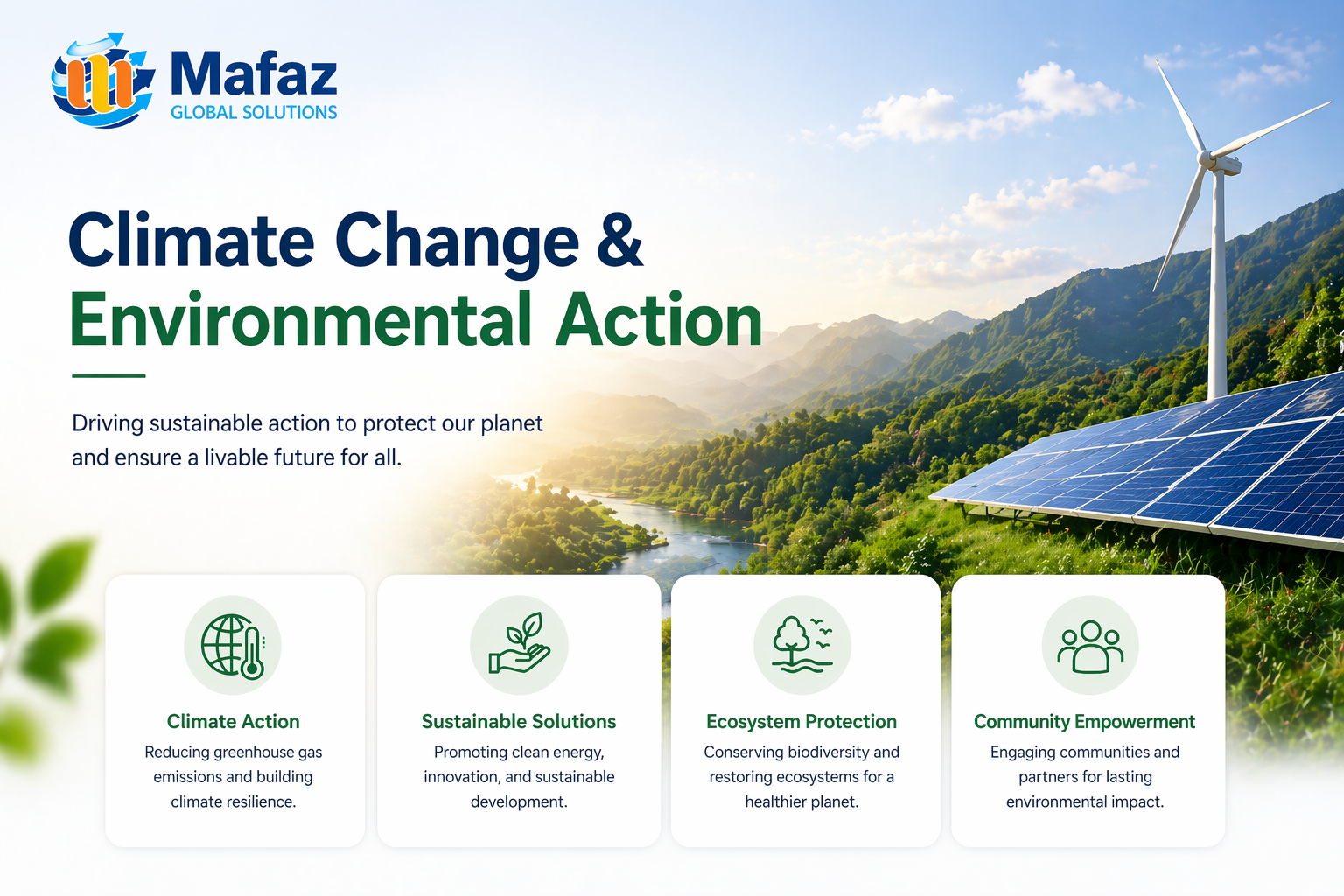
Climate change is one of the most urgent and complex challenges facing humanity today, with far-reaching impacts on ecosystems, economies, and communities worldwide. Rising global temperatures, extreme weather events, sea-level rise, and environmental degradation threaten livelihoods, food security, water availability, and public health disproportionately affecting vulnerable populations. Addressing climate change therefore requires coordinated, inclusive, and evidence-based environmental action that balances ecological protection with sustainable development.
Effective climate action begins with reducing greenhouse gas emissions while accelerating the transition toward clean, renewable energy systems. Promoting energy efficiency, expanding access to renewable energy sources, and supporting low-carbon technologies are critical steps toward mitigating climate change and achieving long-term environmental sustainability. These efforts not only reduce environmental harm but also generate economic opportunities, create green jobs, and enhance energy security.
Equally important is strengthening climate adaptation and resilience, particularly for communities most exposed to climate-related risks. Climate change already affects agriculture, water systems, and urban infrastructure, increasing the frequency and severity of floods, droughts, heatwaves, and natural disasters. Environmental action must therefore prioritize disaster risk reduction, climate-resilient infrastructure, and nature-based solutions that help communities adapt to changing environmental conditions. Integrating local knowledge and community participation is essential to ensure that adaptation strategies are inclusive, context-specific, and sustainable.
Protecting and restoring ecosystems plays a central role in addressing climate change. Forests, wetlands, oceans, and biodiversity-rich landscapes act as natural carbon sinks while supporting livelihoods and ecosystem services. Environmental action focused on conservation, reforestation, sustainable land use, and biodiversity protection helps mitigate climate impacts while preserving natural resources for future generations. Sustainable resource management—including responsible water use, waste reduction, and pollution control—is fundamental to preventing further environmental degradation.
Environmental advocacy, education, and governance are also critical pillars of climate action. Raising awareness, promoting environmental stewardship, and strengthening environmental policies empower individuals, communities, and institutions to take meaningful action. Transparent governance, evidence-based policymaking, and strong institutional frameworks support accountability and ensure that climate commitments translate into tangible results. Aligning environmental action with national priorities and global frameworks, such as the Sustainable Development Goals and international climate agreements, enhances coherence and impact.
Ultimately, climate change and environmental action demand collective responsibility and long-term commitment. By fostering partnerships among governments, civil society, the private sector, and local communities, sustainable solutions can be scaled and sustained. Protecting the environment is not only an ecological imperative but also a foundation for economic stability, social well-being, and intergenerational equity. Through inclusive, strategic, and sustained environmental action, societies can build a more resilient, sustainable, and livable future for all.
Migration is a defining feature of today’s interconnected world. People move across borders in search of safety, dignity, opportunity, and stability. While migration can bring social and economic benefits to both origin and destination communities, it also presents complex challenges — especially when vulnerable individuals are exposed to exploitation, unsafe journeys, trafficking networks, and weak protection systems. At Mafaz Global Solutions, our Migration, Anti-Smuggling & Human Protection work focuses on promoting safe, orderly, and rights-based migration while strengthening systems that protect human life and dignity.
A Human-Centered Approach to Migration
We believe migration policies and programs must be grounded in human rights, evidence, and compassion. Migrants — including refugees, displaced persons, youth, and families — often face barriers such as lack of legal pathways, misinformation, limited access to services, and social exclusion. Our approach places people at the center of every intervention, ensuring that programs respond to real needs while supporting communities and institutions to manage migration effectively.
Through research, data analysis, and field engagement, we help stakeholders understand migration patterns, risks, and opportunities. This allows governments, humanitarian actors, and development partners to design strategies that balance border management, community resilience, and protection outcomes.
Combating Smuggling Through Prevention and Awareness
Smuggling networks thrive where there is desperation, misinformation, and limited access to safe migration channels. Rather than focusing solely on enforcement, our work emphasizes prevention through awareness, education, and community engagement. We support campaigns that inform individuals about the risks of irregular migration, deceptive recruitment practices, and unsafe travel routes.
Community-based initiatives are a key part of this effort. By partnering with local organizations, youth groups, and civil society leaders, we help deliver culturally relevant messaging that empowers people to make informed decisions. Education and livelihood programs also play a preventive role by addressing the root causes that push individuals toward risky migration pathways.
Strengthening Protection Systems
Effective human protection requires strong institutions and coordinated responses. Mafaz Global Solutions works with governments and partners to improve policies, legal frameworks, and service delivery systems that safeguard migrants and vulnerable populations. This includes:
- Enhancing referral mechanisms for individuals in need of protection or assistance
- Supporting child- and youth-friendly protection approaches
- Promoting access to legal aid, psychosocial support, and essential services
- Strengthening coordination among border authorities, social services, and humanitarian actors
Our goal is to help build systems that are not only responsive during crises but also sustainable in the long term.
Supporting Safe and Dignified Mobility
Migration should not have to mean risking one’s life or rights. We promote safe and dignified mobility by supporting initiatives that expand access to reliable information, legal migration pathways, and ethical recruitment practices. This includes working with stakeholders to develop policy solutions that reduce vulnerabilities and ensure migrants are treated with fairness and respect.
By integrating technology, data tools, and innovative outreach methods, we help stakeholders reach migrants where they are — whether through digital platforms, community hubs, or regional coordination mechanisms. These efforts contribute to transparency, accountability, and trust between migrants and institutions.
Protecting Youth and Vulnerable Groups
Young people are often disproportionately affected by unsafe migration practices. Many face pressure from economic hardship, conflict, or limited opportunities, making them more vulnerable to exploitation by smuggling networks. Our programs prioritize youth protection by offering life-skills training, mentorship, and community support initiatives that build resilience and expand alternatives to risky migration.
We also emphasize gender-responsive and inclusive approaches, recognizing that women, children, and marginalized communities may experience migration differently. Programs are designed to ensure equal access to services, promote inclusion, and strengthen community cohesion.
Partnerships That Drive Impact
Migration challenges cross borders and sectors, requiring collaboration between governments, UN agencies, development organizations, and local communities. Mafaz Global Solutions serves as a bridge between these actors, fostering partnerships that align humanitarian, development, and policy priorities.
Through joint initiatives, technical advisory services, and capacity-building programs, we help partners strengthen coordination and share knowledge. This collaborative approach ensures that solutions are comprehensive, scalable, and responsive to evolving migration dynamics.
Evidence-Based Policy and Research
Sound policy decisions depend on reliable data and analysis. Our team supports research initiatives that explore migration trends, risk factors, and the effectiveness of protection strategies. By combining field insights with global best practices, we help policymakers develop solutions that are both practical and forward-looking.
Monitoring, evaluation, and learning (MEL) frameworks are embedded in our work to track progress, identify lessons learned, and improve outcomes over time. This commitment to evidence ensures that programs remain adaptive and impactful.
Building Resilient Communities
Migration does not only affect those who move; it also shapes the communities they leave behind and those that receive them. We work to strengthen community resilience by promoting social cohesion, inclusive dialogue, and local ownership of solutions. Programs often focus on education, employment opportunities, and community engagement initiatives that reduce tensions and foster mutual understanding.
By addressing the broader social and economic factors linked to migration, we help create environments where individuals can make choices based on opportunity rather than necessity.
A Vision for the Future
Our vision is a world where migration is safe, informed, and guided by respect for human dignity. Through our Migration, Anti-Smuggling & Human Protection initiatives, Mafaz Global Solutions aims to transform challenges into opportunities for collaboration, innovation, and sustainable development.
We continue to work alongside partners to strengthen systems, empower communities, and promote policies that protect people while recognizing the positive contributions migration can bring. By combining strategic insight, local engagement, and a commitment to human rights, we strive to ensure that every individual — regardless of their journey — is treated with respect, safety, and hope for a better future.