
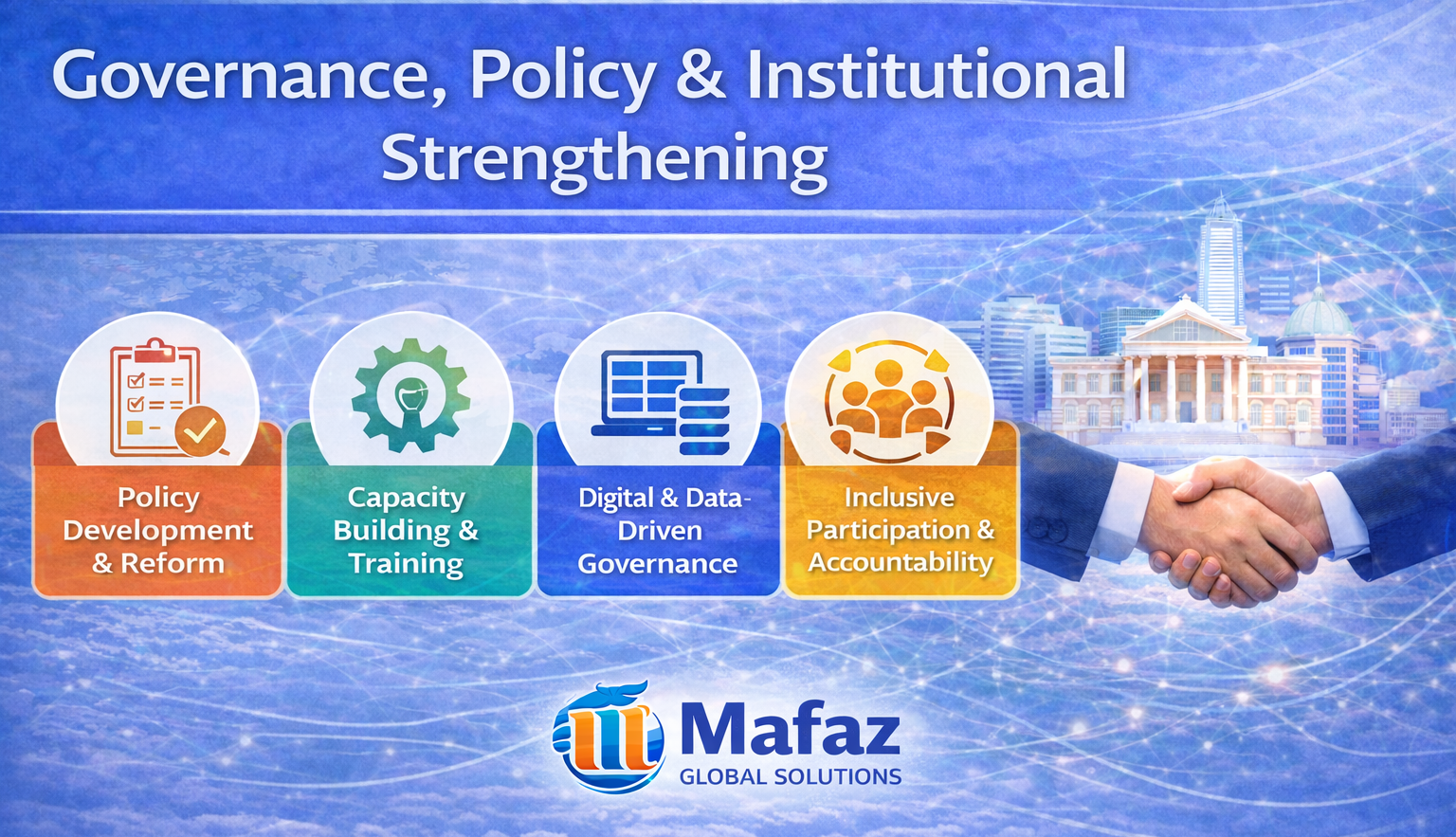
Strong governance and effective institutions are essential for sustainable development, social stability, and inclusive economic growth. Governance, Policy & Institutional Strengthening focuses on helping governments, public institutions, and partner organizations build systems that are transparent, accountable, and responsive to the needs of people. By improving how policies are designed, implemented, and evaluated, this focus area contributes to long-term resilience and better public service delivery.
At its core, governance is about how decisions are made and how resources are managed for the public good. Many countries and communities face complex challenges such as limited administrative capacity, fragmented policy frameworks, or gaps between national strategies and local implementation. Through targeted technical support, capacity building, and collaborative partnerships, programs in this area aim to close these gaps and create institutions that are more effective, inclusive, and sustainable.
A key component of Governance, Policy & Institutional Strengthening is policy development and reform. Evidence-based policy design ensures that strategies respond to real needs and are grounded in research, data, and stakeholder consultation. This includes supporting governments to draft new policies, revise existing frameworks, and align national strategies with international commitments such as the Sustainable Development Goals (SDGs). By integrating data analysis, community input, and cross-sector expertise, policies become more practical, realistic, and impactful.
Another important element is institutional capacity building. Institutions are only as strong as the systems and people that sustain them. Programs often focus on strengthening leadership skills, strategic planning, financial management, digital governance, and service delivery mechanisms. Training workshops, mentoring programs, and peer-to-peer learning exchanges help public officials and organizational leaders build the skills needed to manage complex programs effectively. Over time, this investment in human capital creates institutions that are more resilient and better prepared to respond to evolving challenges.
Transparency and accountability are also central to strong governance. Communities need to trust that decisions are made fairly and that public resources are used responsibly. Governance initiatives may support the development of monitoring systems, open data practices, and community feedback mechanisms that encourage participation and oversight. When citizens are informed and engaged, institutions are more likely to deliver services efficiently and equitably. Strengthening accountability processes not only improves outcomes but also builds confidence between institutions and the communities they serve.
In many contexts, governance challenges arise from limited coordination between different sectors or levels of government. National policies may not fully reflect local realities, and local actors may lack the resources or authority to implement programs effectively. Governance strengthening efforts often promote multi-stakeholder coordination, bringing together government agencies, civil society organizations, development partners, and the private sector. By fostering collaboration and shared responsibility, these initiatives help align priorities, reduce duplication, and maximize the impact of available resources.
Digital transformation is becoming increasingly important in modern governance. Technology can improve efficiency, enhance transparency, and expand access to services, especially in remote or underserved areas. Institutional strengthening programs may support the introduction of digital systems for data management, public service delivery, and performance monitoring. However, digital solutions must be inclusive and secure, ensuring that they protect privacy while remaining accessible to all communities. By integrating technology thoughtfully, institutions can become more agile and responsive to the needs of citizens.
Governance, Policy & Institutional Strengthening also emphasizes inclusive participation. Effective policies must reflect the perspectives of diverse groups, including youth, women, marginalized communities, and people affected by displacement or conflict. Participatory approaches encourage dialogue, empower communities, and help decision-makers understand local priorities. When individuals feel that their voices matter, they are more likely to engage in civic processes and support collective solutions.
In fragile or rapidly changing environments, strong institutions play a crucial role in promoting stability and resilience. Governance initiatives may focus on strengthening local governance structures, improving crisis response coordination, and supporting long-term planning that balances immediate needs with sustainable development goals. By building systems that can adapt to uncertainty, institutions are better equipped to navigate social, environmental, and economic challenges.
Another important aspect of this focus area is monitoring, evaluation, and learning (MEL). Effective governance requires continuous improvement, which depends on measuring progress and learning from experience. Programs often establish frameworks that track performance indicators, assess policy outcomes, and identify areas for refinement. By fostering a culture of learning and innovation, institutions can adapt their approaches and ensure that policies remain relevant and effective over time.
Partnerships are at the heart of Governance, Policy & Institutional Strengthening. Collaboration with governments, United Nations agencies, civil society organizations, and development actors helps ensure that initiatives are aligned with national priorities and global best practices. These partnerships enable knowledge sharing, resource mobilization, and coordinated action, creating solutions that are scalable and sustainable. Working together also promotes consistency across sectors, which is essential for addressing complex challenges such as migration, climate change, and social inclusion.
Sustainability is a guiding principle throughout this work. Rather than creating temporary solutions, governance strengthening focuses on building systems that continue to function long after specific projects end. This includes supporting local ownership, strengthening institutional frameworks, and embedding best practices into existing structures. By prioritizing sustainability, institutions become more self-reliant and capable of driving their own development pathways.
Ultimately, Governance, Policy & Institutional Strengthening aims to create environments where policies are clear, institutions are capable, and communities are empowered. Strong governance lays the foundation for effective programs in every sector—from youth empowerment and community integration to environmental action and human protection. By investing in policies, systems, and people, this focus area contributes to more inclusive societies, stronger public institutions, and lasting positive change.
Through evidence-based strategies, collaborative partnerships, and a commitment to transparency and accountability, governance initiatives help transform complex challenges into opportunities for growth and innovation. As institutions become more responsive and resilient, they can better serve communities, promote trust, and support sustainable development for future generations.